Browser Market Pollution: IE[x] is the new IE6
You may soon be developing for 76 browsers.
(╯°□°)╯︵ ┻━┻
Lemme take a step back… So it's fair to say that for most of us, IE6 has gone the way of the dodo. Good! Now in IE7, we have less CSS issues, working PNGs, but pretty much the exact same JavaScript engine (though faster). IE8 gives a few more goodies (localStorage, postMessage, hashchange event) that'll be nice to use when we retire IE7, but IE8 will be with us for a while.

Since Windows XP still accounts for 46.6% of Windows users, IE9+ adoption has a significant upper bound. More: How Microsoft is handicapping its own web browser and IE9 adoption is painfully slow. Google to the rescue?
IE6 has been a source of pain for… I'd say four years. IE8 will be a source of pain for the next 9, it appears. You're clearly aware that IE9 (and IE10…) are not available on Windows XP, even though Firefox and Chrome continue to ship versions for that operating system (still 40% of the Windows market), so unless the whole world shells out $79 for an upgraded OS, they won't get an upgraded browser, without switching. That's terrible, clearly. But this isn't the worst part. No, no…
How many browsers would you like to support?
Personally, I'm totally happy supporting the latest version of each of the five browsers. IE10 will be a very impressive browser, and the latest releases of Chrome, Firefox, Safari, and Opera are all incredible as well. Supporting the legacy versions is not exactly my idea of a good time, but ya know.. With IE6,7,8,9.. I'm used to it.
It's about to get worse
IE looks to be on a yearly release cycle. Great! IE10 out in March-ish.. IE11 a mere 52 weeks after that. (Mind you, Firefox and Chrome are shipping every 6 weeks these days). But what's far more important than shipping frequency, is the browser half-life.
Products like Windows and Office have a lifecycle policy that typically runs 10+ years because that’s what these organizations need. As part of Windows, IE honors that 10+ year commitment.
~Dean Hachamovitch, IE Corporate VP
IE9 and IE10 are both scheduled to be sunset (as far as official Microsoft support) in 2020. Since IE8 shipped with Windows 7, we can expect the same death date for it. Yes, IE8's death date is 9 years from now. Meanwhile, you won't have to worry about supporting Firefox 6 or Chrome 13 in November.
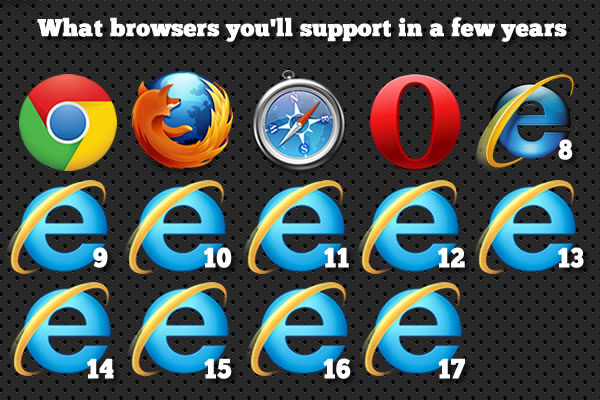
Extrapolating this, if they maintain the same policy, IE17 be released in 2019, before IE8, 9 and 10 finally die. So in a few years from now, you'll be supporting one version of Chrome, one version of Firefox, one of Opera, (probably) one of Safari, and ten versions of IE.
Did I say 10 versions of IE? I meant to say 72.
72 versions of IE on the wall, 72 versions of IE… Maybe drinking beer at this point in the post would be a smart move.
So you're aware that IE ships with multiple document modes. IE essentially ships with legacy versions of the renderer so that you can upgrade your browser but still see content that was terribly coded and cannot withstand the reality of web development, therefore it needs to be locked into a single version. I worded this differently a bit ago.
We seem to be using this term of “intranet apps” or “internal corporate apps” just as a euphemism for poorly written code.
Consumer facing apps have been handling new and unknown browser versions day in and day out for years. Like Kroc said, “Corporate users should be testing their applications against standards, not browser version numbers.”
So IE9 contains IE8, IE7, and IE5 modes. IE10 contains modes for IE9 and on down the line.
The problem percolates when you come to terms with the fact that many of these modes are not the same as the original browser. For example:
- IE8's IE7 mode: adds sessionStorage & localStorage, false positives on a feature test for the hashchange event, mishandles rowspan, and some other event and attribute differences.
- IE9's IE8 mode: intermittently false positives on a feature test for inline SVG. Renders CSS differently than true IE8, and is crashier than the real one.
These are not browsers with reliable replicated browser versions embedded, these are frankenstein versions that behave unpredictably. (To better understand the internals, the new JScript engine (these days it's called Chakra) is used in the compatibility modes, but IE engineers remove features and add bugs to make them "match" earlier behavior. Luckily they run at their modern speed, but run with a whitelist of bugs being put in place. MSFT has all reason to keep these compat modes as identical as possible, so we should expect fewer issues in IE10+'s compat modes.)
Of course, there is the matter of what % of market share it takes for you to "support" a browser (test against during dev / QA against / customize your experience for).. It's possible some of these IE versions won't have enough numbers for us to care. Kind of like how we support Firefox 3.6 and 6, but not 4 or 5. (btw, Mozilla will soon pull the lever to prompt 3.6 users to upgrade).
Where, from here? Do we have solutions?
All this news isn't the best, certainly. What are our options?
Asking your users to upgrade their IE version to the latest? We've been naively doing this for a while now, but we've only been shooting ourselves in the foot. Without an upgrade policy for IE that takes the web seriously, you can't responsibly ask your users to upgrade to the latest IE (the future's boat-anchor browser.)
boat-anchor browser (noun): the browser with enough users and not enough capability, holding back the potential of the web. [via]


IE version pigpile. Chrome's silent auto-updates (charts via arstechnica)
Microsoft's move. Maybe the IE team will introduce a way to upgrade their users well and also serve their business audience that are interested in a snapsnot of the web that doesn't change. Maybe they'll also introduce a better solution for testing in their browsers than running four (soon five) unique Windows OS images.

Chrome Frame gives us a solid option for handling this situation. (Also, if you haven't read these three posts by Alex Russell… do so.)
At the very least, Chrome Frame will automatically update and has the user-perceived benefit of being "just a plugin" (that all users can install) instead of switching to a whole new browser.
I'm almost done, I swear
Clearly, having your users on a browser that not only iterates quickly but appreciates developers by guaranteeing a short browser half-life is a boon to you and the success of the experiences you can deliver. All the browsers are racing to deliver features and speed to you and your users (including IE).
Seriously, all browser engineers are doing incredible, fantastic work. But without a strategy for how this turns out in the long term, this IE situation will become a complete mess—costing you enormous time in designing how scale your design to 76+ browsers, testing it, QA'ing it, and maintaining it.
The IE team is incredibly talented and wise; I think they have a great opportunity here to make the right move (like when they reversed policy on X-UA-Compatible). Perhaps with Win8 and Metro we'll see a more aggressive approach towards bringing the full potential to the web to all its users.
Now, I apologize for writing what seems to be a less-than-optimistic post. But truly, from the conversations I've had with the IE team to everything said publicly on the matter, this looks to be the impending reality. I'd be happy to correct or amend this post with any facts that conflict with the picture I've painted above.
It's also worth pointing out (thx James Pearce) that this post doesn't mention mobile. Are desktop browsers relevant in 5-10 years?
Anyway, Sylvain says: "Bottom line: I think all you have established is that things will probably not turn out that way." So that's good! :) Exchange here: 
Who's to say we'll even be "browsing" in 10 years? In the last 10 years alone, mobile browsing has been introduced, which this article does not account for.
Sure it's fun to think of all the iterations of browsers out there, but who knows what may change in the next 10 years given the insanely fast evolution of the internet.
a great dose of reality..thanks paul for putting this in perspective.
Excellently written article. I would like to posit the notion that FF are heading to causing similar issues also. You referenced that we wouldn't need to worry about supporting FF6 from November, but while Chrome's updates are enforced, FF's aren't.
I often find people using FF, more than IE, but they are also often using 3.5, or 4… Certainly not 6 or 7.
I'm not suggesting that FF has as much to answer for as IE, but their delivery method really needs to be more proactive and Chrome-like, or we'll end up in the same mess as we are with IE… asking older browser users to please update, if it's OK.
@Stephen Sweetland
Currently there is a good crop of users on FF 3.6. None on 4 or 5. Then most on 6.
Mozilla plans to "pull the lever" for 3.6 users to bring them up to date, but hasn't done that yet, intentionally.
They are moving towards an update method similar to Chrome very rapidly, so I'm not too worried. They're def on the right track.
Well, time to find a new profession. :(
Either that or force Chrome Frame on everyone… which might not lose as much money as wasted time testing all these IE's…
I wish you were less gentle :)
IE fornever
You've stated things very well but it proves a point I always make. Internet Explorer has been a thorn in every web developer's side for a decade and will continue to do so. A million souls would heave a collective sigh of relief if it were to go away but, unfortunately, it may never happen.
Shouldn't you also add a dozen or so revisions of FireFox? Because FF's fast iteration also doesn't guarantee user's swift update, and while technically FF's revisions are much closer together you still have to QA everything?
One of the biggest obstacles to users upgrading IE is that the process historically been an extensive and potentially dangerous ordeal. It's a rare IE upgrade that hasn't required a number of steps, a reboot, and probably some tinkering to get it to work the way you want once that's done.
Chrome upgrades, on the other hand, are absolutely invisible. Firefox a little less so, but still not scary.
In any event, the damage is done. I am not sure what the upgrade procedure for IE9 is going to look like, compared to older IEs, but hopefully it's a little less intertwined into the workings of Windows and can be updated more easily. But if it's still going to require a wizard with a half-dozen steps and a reboot, then I think we can expect the stagnant upgrade situation to continue.
Paul,
I've been fretting on this topic myself for some time. How can we kickstart a change in the corporate mindset (and IE mindset) to stop supporting this bad code and re-write it to be standards-based code? That's what needs to happen. I think we need to find a way for it to seem profitable to them :) They need to know that it will make them X dollars and X cents before they will make the change.
I deal with that every day at my job, "We're sorry, but that new Windows 7 PC you just bought wont work with our portal software because of IE8."
To me, Its a matter of pride. All my apps are written to be cross-browser compatible. But that pride stops with me, because they don't see any money in it.
This is a really great post, and I'm glad you wrote it. Thanks.
Typo: I think
ↁ_ↁ
should have been
(╯°□°)╯︵ ┻━┻
I posted on Google+ a short overview of why IE8 will doom the web. This is a much more thorough post, and I appreciate seeing this explained so thoughtfully.
It seems to me that Microsoft has the web by the balls, and they know it. Facebook and Google are perhaps best prepared to combat Microsoft's tyrannical grasp by simply not supporting Internet Explorer PERIOD. No development for IE, no testing in IE, nothing. If something breaks in IE, who gives a shit?
Even better would be to simply refuse to serve content to users running IE, and give them a message to download the latest version of another (any other) browser instead.
You can point fingers all you want, but Microsoft's responsibility is not to make the web a better (or even a good) place, there responsibility is to maximize shareholder value. In this case, wasting resources on making Internet Explorer a responsible web citizen would likely be contrary to that responsibility. Microsoft isn't ever going to change for us. We need to force them to change.
The other enemy is the legion of "Enterprise" software developers that are developing against standards. These developers have corporations in a chokehold with long service agreements, and poor data liberation strategies. They make it vastly cheaper for a corporation to suffer with what they have than to switch to something better. Most major corporations are still suffering the consequences of decisions made before anyone even thought the web was going to be a big deal.
If we ever want Internet Explorer to grow up into a responsible adult, we need to fight the status quo aggressively. Unfortunately no one (least of all the organizations that actually have the power to do something about it) has any real incentive to fight this war.
Thank you Paul for writing this very detailed post! It shall now be passed over to the "business people" I work for … they are the ones that need "enlightenment". I'm pushing Chrome Frame at any chance I get.
Are there any public stats on Chrome Frame adoption rates? Surely this is going to boom as larger companies drop OldIE support….?
Also Eric Meyer maintains a nice Browser History Timeline you might be interested in: http://meyerweb.com/eric/browsers/timeline-structured.html
@Adam J. McIntyre
Typo fixed. :)
Why doesn't the spreadsheet show the modes for IE6 (IE5.5, IE6), IE7 (IE5.5, IE7) and IE8 (IE5.5, IE7, IE8 Standards, IE8 Almost Standards)? Fortunately, there's only one difference between IE8 Standards and IE8 Almost Standards and only one between IE9 Standards and IE9 Almost Standards. Well, AFAIK, at least.
@Henri Sivonen
Good call Henri. I left out quirks and almost-quirks but you're definitely right that we've got many modes at play already. :/
I basically simplified how many versions there are, in reality there's more. :(
Does Safari also suffer this problem, coming bundled with versions of OSX? AFAIK only Chrome and Firefox do inline upgrades in the browser, could be wrong.
@Jeremy Alt
Safari's handled through OSX's Software Update, so yes, it would suffer from potential lock-in due to users neglecting to upgrade.
What (sort of) saves us is Mac users are generally fairly rapid upgraders.
I was thinking a similar thing about Firefox… but worse in that they upgrade every six weeks. They will have 720 versions by the time MS has 72.
Most organizations will be forced to choose which browsers to support due to their limited resources (time, money, developers…) and we'll wind up back in the land of "Optimized for …" or a million different polyfills or one giant IE-backward-compatibility stylesheet to rule them all.
However, being forced to support OldIE for so long, we've created new best practices around supporting old (read: terrible browsers): would we have graceful degradation without old browsers to degrade our experiences in? Eventually, the community will develop the same best practices around supporting IE∞ as we did around supporting IE6, things will evolve, and we'll make do somehow.
I don't think IE team flow this release cycle for Win8. They are aware of browser market and will make release cycle of IE shorter.
The main problem with IE update is that it's locked to Windows Update and many users have Windows update turned off. They should make it independent from Windows Update.
I'm surprised Microsoft has yet to come up with a solution to this, or even seem concerned. It really puts them in a bad light being a supposedly innovative forward-thinking technology company, holding back progress so much…
Paul, You're absolutely right and make some fantastic points that I've never really considered. Thanks for sharing and keep up the good work!
Paul, I think this is your best post ever!
Paul,
Why won't my printer work?
I couldn't agree more with your closing paragraphs there. Microsoft have a fantastic opportunity with Windows 8 to finally provide the real web experience to its users. They've been making great strides in software recently and it's about time that Internet Explorer stops holding back innovation on the web. I sincerely hope Microsoft makes a big push for this!
It seems feature detection and progressive enhancement/graceful degradation/hardboiled will be the ways to go here. I haven't played around a lot with IE9 yet, but its bug list seems to be really small in comparison to its predecessors. I think developers will create their own cutoffs (current IE + 2 versions back) and whatever features aren't supported beyond that point will just get a standard "simplified" version of the site, although simplified will still be pretty impressive by today's standards.
Also, don't you need to enable "Developer Mode" or somehow manually show the Developer Tools to get access to Document Modes. The only people who will know about running in older document modes will be devs and IT who require the companies to run their intranets on these old document modes so I think the consideration of accommodating IE13 in IE8 mode will be limited.
Last, when all the corporate intranets were developed to run on proprietary IE tech, the web was a much different place and, admittedly, IE did offer a lot of cool stuff so long as you drank their cool-aid. I think with the way the web has progressed and remembering the nightmares of being locked into old tech, the corporations may look to develop future intranets in less version-locked format. It would certainly save them money in IT costs.
i've always found the different document modes in IE to be the "new" (since they've actually been out for a while) quirks mode that IE6 has so famously been known for. which is of course a terrible idea.
"IE6 has been a source of pain for… I'd say four years."
I've been coding CSS layouts for more than ten years, and my workflow has always been 1. Make it work in Mozilla's browser. 2. Fix the IE bugs.
IMHO, IE6 has been a source of pain for as long as it has existed.
Good article otherwise. :)
@Paul Irish
I'm still amazed that Google is getting away with the quiet updates. MS did that to WinXP a decade ago and caught hell for it.
A related point that needs to be considered: the costs of frequent upgrades in large organizations. I suspect there is a correlation between legacy IE use and large IT department browser policies.
For the people commenting about Safari and IE upgrade cycles being locked to the system updates: each OS uses HTML rendering in other contexts within the OS and so the rendering engines for their respective bundled browsers are part of the system framework. That's why you have to system restart Windows AND Mac when there's a browser upgrade. Same goes for why Mobile Safari only gets updated with iOS updates. FF and Chrome are self-contained and bundle their own rendering engines so it's easier to upgrade those quickly.
That’s interesting. In you analysis he should consider where the users are located. I think its important to isolate relevant markets, as they affect this stat tremendously. If you removed 180 countries from the stats, and eliminated internet game cafes in China, the numbers would look substantially different, and more relevant to developers and businesses who don’t target those eliminated markets.
While this may be true, it may as well not. Not because of a Microsoft policy change, but because of a strategy change.
More and more, not only webdevs have (desktop) browsers to test against, but also mobile browsers. And despite features helping mobile developement (like media queries), it still requires testing, QA-ing.
Soon, Metro apps on Windows 8 will be a new web platform to test against, because it can be sure that webdevs won't simply wait for people to launch a web browser. No, they surely will want to be a "native app" (which i would define as "something you open by double-clicking on a desktop shortcut").
As some predict, the browser may be a transitional technology (http://www.slideshare.net/allenwb/is-the-browser-a-transitional-technology) and it may not be impossible to think that by 2019, there won't be much IE versions, but rather as many "web-capable" platforms.
We'll see!
Additionally we need to be aware that Metro will bring a new touch interaction model that is different from the iPad, PlayBook and other touch devices so that developers will have to split their code out even more – causing even more browser splintering.
Sorry Paul. Complete #fail for not mentioning mobile. You really think we'll care about anything else in 2020?
@James Pearce
You type that comment on a keyboard or your phone?
"Maybe they'll also introduce a better solution for testing in their browsers than running four (soon five) unique Windows OS images."
They already have, it's called SuperPreview and it's part of Expression Web: http://expression.microsoft.com/en-us/dd565874.aspx
@Juliana Peña
Juliana, SuperPreview only currently is a screenshot viewer if I'm not mistaken. We need to interact with these browsers not just view their snapshots.
i hope all browser vendors change to a chrome like update politc. i mean autoupdate so everyone that uses the browser for the web has automaticly the newest version!
do this MS
The bigger issue is that Firefox, Chrome and Opera are chosen for use by technically competent people, or at least made the "default" browser for the "non-technical" so that they then tell the user they need to install an update and keep themselves current. Where as, because IE has so many "windows" features, and so much "specific brokenness" due to MS letting their "corporate customers" control the policy, IE is not automatically updated, and doesn't continuously attempt to persuade you (well until recently it did not). The end result, is that IE, by design, is not a "current" or "up to date" tool.
MS has no idea, from my perspective, how to "manage" product life cycles for the users. They are managing life cycles based on "corporate customers", who believe they know exactly what is best for their "users".
MS needs to separate themselves from the teat of the corporate customer and stand up for the users, and get this right.
The web is already painful enough. Having to deal with broken browsers just makes it nearly intolerable.
@Grwww
+1
For webdevelopers think of IE as job security, haha. It sucks so bad yet has its own market that you need to support that people/company are willing to hire you to fix stuff.
My browser stats may be off, but I'm finding a good number of people aren't auto-updating Firefox. For sure I'm still supporting Firefox 3.6 in addition to recent releases. Obviously I'm expecting a different situation 10 years from now.
The different compatibility modes in IE are definitely annoying to deal with though. Especially since it's so hard to exert any real control over the compatibility list. Arguably the same issue applies with Opera (see: recent BBC issue), but the Opera marketshare makes it kind of moot.
FWIW, I'm adding in the various compatibility modes into Mogotest. The wide proliferation of browsers is one the big reasons I built the service to begin with. It's not for everyone, but if you want to be sure things look the way you expect on each of these browsers, I think it's a pretty good service for doing so. And sorry for the "pitch" here. I just really think services like this are the only way anyone can reasonably keep up with the pace of Web development.
One has to wonder (because I don't think that anyone can accurately measure this), how many development hours have been wasted and will be wasted supporting browsers that do not follow standards (for the most part) and are there because of some weird 10+ year policy.
The developers of IE are definitely smart people as you stated Paul, no doubt about that. The problem as I see it though, is that the actions coming from Redmont (whether this is a business decision or development one) do affect every web designer.
As time passes and the model you depicted becomes a reality (which I hope it doesn't but I don't keep my hopes up), more and more time will be lost in trying to support old browsers and code work-arounds. In an effort to reach as much public as possible, web designers will have to code against all versions of IE possible and that will be detrimental to the progress of web design and the Internet as a whole. Wasting time in IF statements to ascertain the browser version and issue a hotfix is not innovation.
Sorry for the sour post but I have been burned many a times in the past by IE quirks.
Do you really think that Microsoft will be including all the legacy versions? I can't imagine 10 legacy version in one browser! That's absurd. Microsoft can't afford to do that and they will obviously find a solution.
In the end, only a few number of these IE browsers will continue to live. Those who update their browsers, will most likely be using the latest IE. Those who don't/can't update, will stick to IE8 or maybe IE7. Also, these newer IE browsers, as you mentioned, are following the standards. So if developers are following the standards, there wouldn't be much to worry about.
I think this post is over exaggeration in picturing the future. But it is probably good to get the attention of IE developers and Microsoft to maybe change their policies for a better update system. I believe they already have plans but even if they don't, it's not gonna be this bad. So don't worry!
Excellent article. I wish the future of IE wasn't so bleak. And so absurd.
@Paul Irish Haha; whatever I say, I can't dodge your log files ;-)
(Actually I hacked the Windows 98 registry so that my browser mimics Chrome 15 on OSX)
Sad thing is that even if some XP users wanted to upgrade, their computer can run 7. So now they have to fork out for an entirely new computer, which in this day and time a Windows PC, basic, is nothing in the grand scheme of things.
I've given up IE. If I am doing anything complicated, it's just gonna be Chrome Frame for IE users.
IE8 doesn't have canvas, and a VML shim is too slow, so it's the new IE6…
IE9 doesn't have low latency audio for gaming, so it's the new IE6…
There's always going to be a feature I want that IE doesn't have.
Great post, Paul!
What would you say if (the ugly monster) Microsoft update IE automatically without asking anything to me like (the white angel) Google do on MY computer!
@James Pearce & @Jamie
The exponential growth of mobile is probably going to taper off, like anything does. But even if it does grow at the same rate until 2020, does that mean there will be no desktop browsers?
The word "mobile" should make it clear that such connections are done while people are not at home or not in the office (i.e. they are "mobile"). For the most part, that will add to (not necessarily replace) desktop usage.
Of course, I'm generalizing here, so if there are any stats that indicate otherwise, then I'd be glad to see them. but I think it's safe to say that the web isn't going to be inhabited by homeless and office-less people in 2020. So, regardless of mobile trends, the issues brought up by Paul are still quite relevant and give a pretty good overall picture of where we're headed.
The internet is only 20 years old. Surely after it goes on it's 21st drinking binge it will be smart enough to cut off the slow limbs, right?
Paul, how often have you been testing for Chrome 5 or Firefox 2.5 lately? Soon all browsers will be more flexible, IE8 will still bite us for some time but you'll notice that IE9 users will all upgrade. Don't worry too much, future is bright!
lol, I love how all the cool startup kids hate the reality of the enterprise.
To clarify some points:
1. I love how you can see the fragmented future of IE but don’t talk about the broken present of Firefox, I suppose that you only support FF6 and those FF3.6 or FF4 users be damned.
2. How about the Mac and Safari?
3. What about mobile? The fragmentation is even worse there
And for those complaining about the speed of the enterprise, remember kids it's not the same going to twitter and get mad because it's down to going to your bank and realizing some transactions are lost, not everything is about instant gratification, some things needs to be reliable.
@Juan
1. Currently, it's worthwhile to support ff 3.6 and latest stable (6). In a few months the 3.6 users will be transitioned up. 4 and 5 FF users are not really significant enough to require testing atm.
2. Safari 5.1 and 5.0 are both worth supporting. 4 is dead.
3. Yup it is.
Do you think many web designers would actually attempt to support 76 version of IE? I see the point of the argument, but I have a feeling the "common" web designer is not going to bother wasting much time support much more than 2-3 versions back. I can only hope that as time goes on and users get frustrated with their crappy experiences, they blame it on IE, not coders, it will only cause more and more users to switch to a new browser.
why not just stop supporting IExx and concentrate on standard features ? if all websites had a splash screen suggesting to the user to update his IExx to something standard, the IExx half-life would shorten dramatically and may be M$ would finally learn something.
@Juan
Your condescending rant is misplaced.
Some of us have spent a decade jumping through hoops to make things work on IE and are tired of it. "Kids" don't have years of being jaded under their belts, experienced programmers do.
Chrome Frame deals precisely with the reality of the Enterprise. In the Enterprise it's expensive to move off of legacy apps that were built for specific IE versions. Chrome Frame lets us write code to coexist in that universe while not being bound to it.
@Jamie
Agreed. Update's that don't feel like updates or where you have to do anything are the way forward. The thought of any more versions of IE does not make me happy. I hear mobile IE is pretty terrible too.
Good use of data to make an extremely ridiculous conclusion. Of course realistically nobody important is visiting your site with IE6, even google stopped supporting IE6 and I haven't supported IE6 on my sites for years. By the time IE12 is out IE9 will be dead, things are changing.
Great article. Hope Windows is still around till 3/12/2022.
There will be a point when the situation will be unbearable and decisions will be made. I don't believe there will ever be a time where we'll be supporting IE8 to 17, or where the differences between these versions will be so obscure that it doesn't matter anyway.
Microsoft might be releasing a new version of IE every year, but they're also dropping support for 'legacy' operating systems much faster than they used to and releasing new OSes at a faster rate. This might lead to more of an Apple like way of living where even novice users update their OS and thus updating their browser. It might not, but who knows.
In the end it's the user who makes the choice to use an older operating system and browser and he has to accept the fact that in one way or another he will be left behind by making that choice (which is not always voluntarily of course).
I believe Microsoft will do everything in its power to make users more apparent of what a browser is and what it means to have a newer version, just to avoid situations like this and to tighten their grip on the internet again.
Wouldn't the real solution for this just be for Microsoft to produce a version of IE that will work all the way back to WinXp and installable?
I think the big issue is that Web browser features are used throughout Windows to display desktop UI and that's why older versions need to continue to work. Changing the browser engine would potentially break a lot of those apps so like it or not continuity is actually somewhat important.
However I see no reason that IE couldn't be created as a side by side version – one that you use for browsing and one that's used internally to match up with the OS.
The worst thing about this article is the attempt to use backwards compatability as a "version to code for". What kind of garbage is that? By that reasoning, there's going to be over 150 different versions of Firefox and close to 90 for Safari then, but you didn't mention ANYTHING about that.
Nothing here…. if you don't want to support IE because it can't do something you want, it isn't 'holding you back'.
Grow up. Just tell your users or stakeholders that it isn't possible. The truth is, you don't have the balls to do it!
"The IE team is incredibly talented and wise"
This sounds odd in amongst the rest of your post. Obviously there's no point in pointing fingers, but I would challenge the assertion that the IE team is "wise", in the grand scheme of browser development, and you needn't look further for proof than this-here post.
I guess diplomacy and tact will win the war, as always… (ahem)
I think we all know that supporting a silly number of IE versions is a laughable reality, one that probably won't come to pass. Developers simply won't be bothered. Even now, many are abandoning anything that doesn't support their beloved -webkit-blah. Even for those that attempt wide support end up pandering about with not-so-graceful degradation instead of pursuing a technique which still matters: progressive enhancement. It works too, but devs, even the good ones, are bound by the limitations imposed by businesses that don't realise that they would benefit, financially, from pursuing the compliance of standards and the writing of GOOD code.
What about the mobile browsers? Safari Mobile has various versions out in the wild, and the upgrade policy lags too; similarly the Android browser, which is still bound to Android version (though that may change in future). Are you hoping that portable device upgrade lifecycles are that much faster than desktops we can ignore this?
@Hiram
You seem to think Microsoft is a software company. They aren't and haven't been for some 20 years or more. They are in the business of maintaining their monopoly. Software just happens to be the tool they use to do it.
Microsoft has no interest being being a "good web citizen" or doing anything other than using everything in their power to punish people who would attempt to use someone else's software. They've been doing it so long that's all they know how to do any more.
Sure, there are great engineers at MS, and they are going great work, but management's decisions have all but eliminated any good that can come out this good work. Any great technology that might (and occasionally does) come out of that company will only be used to maintain their stranglehold on the market. Of course, they are losing that stranglehold, but Microsoft will be a millstone around the necks of the software industry for many years to come, until they lose enough power and money so they can't buy their way into any new market. We can see them already slipping in the mobile market, but they still have a lot of ammo (and possibly even some good software, although I'm not holding my breath).
Apple and Google have their own issues, but they are forcing Microsoft to play on a slightly more level playing field than they are used to, and in that, they are providing the public with a tremendous value.
We must make the movement! Not waiting the companies .
We may using technique like what used in PC games : not all feature available for every HardWare and if you
need more features you need more advanced hardware , and we must apply the same methodologies to the
web .
WE MUST TAKE THE WEB FORWARD TO THE NEXT STEP .
you are assuming users will be stuck with each version of IE, which is probably wrong. While this is true for IE6 and IE8, MS won't do the same error with each version of IE, from IE9 on users will be able to upgrade to the latest version …ish.
A small correction: saying half life doesn't make sense, probably. Once half of the userbase has melted away, it's unlikely that it will take the same amount of time to get to a quarter.
To all those trying to make comparisons with running multiple versions of Firefox, there's one big key difference.
When a new version of Firefox is released, the previous rapid release version is marked as End Of Life and is no longer supported by Mozilla, whereas Microsoft intends to support outdated versions of IE for 10 years.
Anyone still running FF4 is running a browser that isn't even supported by Mozilla, so why should developers also support it?
Also, to Lance who suggested that Firefox will have 720 versions when IE has 72: FF doesn't bundle legacy rendering modes. FF7 is FF7 only, not FF4,5,6 and 7 together.
Chrome Frame is NOT a solution yet. It does not support 64bit IE. We could not roll with "just do a chrome frame" just because of it.
Instead of improving user experience, Chrome Frame magnifies the number of variables and further annoys those on 64bit IE constantly prompted to install it, with seemingly no outcome.
The stuff about IE is interesting but the claim that "You only need to support one version of Chrome, Opera and Safari" is flawed.
I cannot foresee the future, but 8 and 9, maybe 10, and then 17 would probably be enough. If there are still browsers and an internet and human engineers who care, though.
As long as MS supports long-term investments of IT departments, there will be always some IE's to support (the IE team cannot simply start to release early and often, and some ITdepartments are very thankful for that). That did not change in the last "four" years, so basically every web developer can live with it. Those who can remember IE5.5 know that developing for IE became a lot easier.
Back in Feb 2005, IE7 was announced. IE bashing was very common, and nobody could think of a decent MS browser like IE9 or IE10. Meaning that bright minds of 2005 failde to see the future.
I don't think this is bad news for web designers, I think it's bad news for Microsoft (and its users).
It makes me laugh when people think that in 2020,we're only going to use mobile devices. In 2020, people are still going to read books and some old-school luddites(sarcasm) are gonna use desktops.
@Paul Irish After all that, it turns out your blog sucks on a mobile browser anyway :-)
@James Pearce
Hahah. Yeah, that is probably true.
*fixes*
Couldn't stop laughing by reading this article, it's funny but the same time so scary.
@James Pearce
OKAY mobile friendly now :D
Paul, Great article. Thx.
As James Pearce commented and you acknowledged, there's no mention of mobile. Given that mobile internet access will surpass broadband access by 2015, this alone will change the roster of user agents available. Perhaps, a larger question is what may be occurring with Chromium OS, a browser-based user interface for the operating system.
Although entirely speculation, I could see further merging where a single UI would provide browser, social network, and OS functions for all our cloud-based activity. (Granted some issues will remain — what runs on which chips, existing branding / products may need to morph, etc.) Should this come to pass, I would only hope that all the teams playing can agree on web standards.
There is a possibility that compatibility mode may or may not be updated. This is explained in the thread titled "Internet Explorer Compatibility Views" Searching…
Neither Google groups nor Google web search finds that on Google Groups.
Found via paginating:
http://groups.google.com/group/comp.lang.javascript/browse_thread/thread/bd7aa80a61687b14
Thanks for great article. You can say that-the whole article-again!
Apart from the article, you had me at following emoticon. lol
(╯°□°)╯︵ ┻━┻
Thanks Paul for a interesting review of the future. As a developer I have abandoned IE lack of functionality and its a pity that Microsoft cant keep to web standards. Its not their world and obviously we can convert everything to work for IE because they dont understand the rest of the world.
Web standards are to be followed and it will kill IE in the long term. Thee is no doubt about it… pity they just ignore the market and living the Microsoft bubble totally unaware of what the web is about and what is happening for about a decade…
That's not totally true. 1.5 % of our users still rely on Firefox 5 – but it's true, more use Firefox 3.6 (6 %). The same for Chrome – 4.5 % use v14, but almost a half of it still "other Chrome versions". This maybe different for tech blogs, but at the mainstream market the browser usage is very diverse.
But apart from that: really great post, sums up everything perfectly!
What about chrome not updating itself behind proxies? I work in a corporation (one of those that still uses IE6) and we managed to switch from IE7 to Chrome (version 9, some time ago) People still have version 9 because Chrome refuses to use the proxy when running the updater… so it fails to update. I've tried everything to make chrome updater work properly but without success. If you want to make Chrome an alternative to IE in companies, just make it work… or if there's a way to do it, document it somewhere (administrative policies are great though)
For me the biggest problem will be for mobile browsers tests because the desktop emulators are not the same as their mobile counterpart.
One example, for firefox mobile (Fennec), Mozilla provide a desktop emulator for it. And i found a bug with being ok on the emulator and not even rendered on the mobile although the detection is positive.
Only way to test them is to have a mobile for each supported version. So iphone for safari (and opera mini), android for firefox and opera, blackberries, …
Also arise the problem of debugging on all those browsers, which still need some love and improvement.
Hey Paul,
Microsoft cannot change this unless they make an IE for corporations and one for general public use. Support contracts, compatibility, security and may other factors make it impossible for MS to push versions like say Chrome.
Windows XP's official support is almost over, so they cannot support IE on XP. Any support contract's minimum length would extend past the end-of-support deadline.
As for Mozilla – the browser I'm writing this in – aren't they trying to get into corporate business as well? I wonder how they will solve the "contract is for support to FF7, FF8 is a new contract, new audit etc".
So, call me crazy, but is there an argument for only supporting, say IE8? Surely with all those backward compat modes, IE22 will still have an IE8 rendering mode? Then, we can simply treat all IE versions as an oldIE, and get on with making everyone elses experience great.
Interesting thoughts, regarding Chrome Frame though, I'm currently planning a large scale rebuild of a travel site at work and we unfortunately have a business case where IE6 support needs to be included because a 3rd party uses it to access the site and Chrome Frame was a strong consideration but doing some research, it may not be a perfect solution right now because there are some accessibility issues (http://www.paciellogroup.com/blog/2009/09/google-chrome-frame-accessibility-black-hole/)
I know the article is a couple of years old but I spoke recently (sept 2011) with the author on Twitter and he wasn't aware of any improvements in this respect.
Something to consider for those wanting to install Chrome Frame possibly.
Cheers,
James | @welcomebrand
@Paul Irish
Automatic updates are potentially evil.
@James
I updated the article you refer to: Google Chrome Frame – still an accessibility black hole? Chrome/chrome frame has made major accessibility improvements, but there are still some issues outstanding.
@Paul Irish
Thats great news! I had asked the question before, but to hear that its going to go that way I find very heartening.
Actually if you were really understanding the way IE support worked you could easily support 1 single old version of IE like IE7 or IE8 and the newest IE version that you need tthe features of in your website.
There is no need to support more than two versions as you can force IE to render your site in an IE version you want.
So if IE is on version 16 you can have your site provide an IE15 tested version (which you can force IE16 to render as IE15 if you fear incompatibilities) and for old Windows versions you can provide an IE8 compatible version which every IE version higher than IE8 can also render.
With chrome and Firefox you would risk that every six week some item on your site is failing. With IE your site can be rendered consistently for years by different browser version that render in the same version that you tested your site for.
Hi there
Yes, this drives me crazy!
I always ask: When you create a mp3 file, you encode it in one version to run in vlc and other to run media player? Nope…because the mp3 format is one, and should be understood by the software which is supposed to understand it! The same for .png files…do you encode it in one format to photoshop and other to image viewer? So why on earth we have to do that with our code?!
I think we should start writing one code with the best of the practices and patterns we can(or know how to) use…if the user chooses a "video cassette" to watch a dvd…well, the user will have problems, but is that our mistake?!
By doing that, we would kind of force the vendors to find a way to keep the users using theyr softwares, happy…instead of learning how to "buy for free a new dvd player"!
I know I wrote a lot, sorry :p but a last thing is that…well, with chrome, firefox and opera, you can access the good websites in linux, mac and windows…safari, for windows and mac…so if you develop something only for IE, your're about to prejudice a lot of people, and deny them the chance of trying new options! Developing websites for IE is almost a crime! hehe
Paul, your writing is so good. You make the article very interesting to read, and obviously you are very knowledgeable in the subject too.
"Yes, IE8's death date is 9 years from now. Meanwhile, you won't have to worry about supporting Firefox 6 or Chrome 13 in November."
Haha great point.
You fail to see that the author has the control over which mode he chooses to use.
If an author is using Standards Mode, he will only have to support the standards mode of that older browsers, and that makes 10 browsers not 72.
Only Library authors (jQuery and what not all) will have to take care here, but they're the minority.
Almost no one uses the X-UA-Header. Is almost exclusively used in intranet applications and the likes.
Also note that long-term support and multi-mode ability of IE actually helps to have IE updated in the company.
Microsoft could limit IE8/IE9 lifespan by releasing Windows 7 servicepack with IE10. Support for OS features that are altered by a service pack ends two years after having been superseded by that servicepack.
@the_dees
Yes. I'm definitely one of the biggest advocates of X-UA-Compatible with IE=Edge so I know this well.
But library authors and framework developers don't have this flexibility, as you point out. And I would argue that if the only third party code you have on your site is jQuery, then there's probably not much going on. Hypothetically libraries could require IE=Edge and promise bugs without that. That'd be fun :)
Facebook blocks older versions of IE than the current = Upgrade policy for IE that takes the web seriously :)
But what if I just grow tired of IE's war and stop caring about it. What if a massive amount of people do the same. Wouldn't that be the solution? A massive, never-before-seen campaign against IE to target people who use IE and make them use a modern browser (anything but IE). I'm just sayin'
To be fair, only a very small fraction of web developers care about Quirks and almost quirks modes. Strict mode or death, which simplifies things a tiny bit.
I do remember that IE9 runs a different JavaScript engine depending on whether or not it's in 64-bit or 32-bit mode (Chakra). Not sure if that has affected anything more than performance. Have you heard anything?
On top of that, the new "Metro style IE" will completely disable addons.
http://www.computerworld.com/s/article/9220042/Echoing_Apple_Microsoft_bans_Flash_from_Metro_IE10_in_Windows_8
Just more variables creating more permutations.
@James
Chrome Frame is as accessible as Chrome is, and that post was written shortly after that post was written (when GCF was *pre-beta*). It's good of Steve to write the newer post and I hope he's willing to update it again in 6 weeks when Chrome 15 is out = )
Regards
http://images.memegenerator.net/instances/400x/10290663.jpg
Awesome article, paints a very accurate picture. I wrote a follow up to this, including what I think Microsoft should do.
http://geddesign.com/post/10775181893/microsofts-golden-ticket-ie10
The biggest bugs for web developers in IE6 are layout bugs. Any browser differences from now onwards will more than likely be functionality bugs: HTML5 APIs; CSS3 animations; speed of JS.
Standards for presentation have mostly been evened out: I can be pretty confident that an HTML-coded page with basic CSS applied will look the same. But the more developers use the File API, Web Workers and other HTML5 functionality, the more important it is that browsers give a consistent response.
Great article, and one that properly highlights IE's serious lack of release strategy compared to the (perhaps overzealous but widely followed) release strategy of Firefox.
some of us already support 76+ browsers, they are called android and while the update policy of ie seems broken in hindsight, the update policy of android was crippled from the get go
OT: Just what exactly is (╯°□°)╯︵ ┻━┻ supposed to be?
99 little bugs in the code… 99 little bugs.
You fix one bug, you open IE
101 little bugs in the code…
(Sorry, couldn't let this one go, right?)
"Clearly, having your users on a browser that not only iterates quickly but appreciates developers by guaranteeing a short browser half-life is a boon to you and the success of the experiences you can deliver."
How exactly a short browser half-life appreciates developers is beyond me. A short browser half-life translates directly to a short half-life of code developers write to run in that browser, which is the exact opposite of being appreciative of their work.
If you want to appreciate developers – and users, for that matter – guarantee a stable platform. Browsers don't have a history of being that.
Beautiful article, Paul. This problem is so easily solved by just merely using cross-browser compatible JavaScript libraries, feature-detection scripts, CSS media queries, image scaling scripts and a hand-full of other "responsive" scripts. Oops, did I say easy… my bad. Lets just put more emphasis on responsive designs!
The fun thing is that I think that as FF and Chrome's fast version number iterations take hold, we'll see IE react, because people will be seeing: Fire Fox 30 vs IE 10, and think that actually means something. Which it doesn't, of course, but that's fine as long as it highlights the difference in versioning systems.
Nice article; however, um, I don't care about IE users now and I don't think that having more different versions of them is going to change that anytime soon.
Well on the plus side at least it means none of us developers will find ourselves redundant in the foreseeable future.
This has to the best article you wrote yet. I originally wrote my cssSandpaper polyfill as a temporary hack, um, solution, but now it seems I will be using it longer than I thought I would be. Damn your refreshing dose of reality! Now excuse me while I shake my fists in the air like William Shatner and scream "KKKHHHAAAANNNNN!!!" :)
Great article Paul, a lot of interesting facts and another reason to add to my list of reasons to stop supporting IE
Chrome isn't exactly the easiest browser to test either. It's very difficult to have more than two versions of Chrome installed on the same Windows machine.
Even Firefox has this same issue. Although you can install different versions of Firefox in different folders, running them at the same time is a no go.
This post is just a bash at MS.
Why shell out $79 for an upgrade when you can upgrade for free? I am talking about linux of course. I am a college student, i dont have the money for that. Id rather spend my money to slowly upgrade my computer over the years so i can keep this 5 year old computer running like brand new. Its a LOT cheaper in the long term.
Paul, as an end user of all these browser – I have to say I don't like it when firefox keeps asking me to update. And I especially HATE when somehow it upgraded without me wanting to upgrade..and the UI changing on me. Now that is me a tech savvy users. Imagine the rest of the browser users who are not as venturous and don't like change to be imposed to them
So while from a dev perspective we need to enforce some sort of upgrade. I am not sure the Firefox/Chrome method is the right one.
Hi Paul, I never understood why end users do not upgrade their web browsers as they are free. I started looking into web design as a career, however was continually frustrated by having to account for old browser softer, and msofts holding back internet technology. I still do a little web design but not seriously anymore. I wish every web designer in the world could just stop supporting IE browsers in their designs, however because of end user complacency or lack of knowledge I guess, this can't happen.
I changed to firefox when I started web design and have never look back since. I just could not believe how much better is was compared to IE. I like Chrome also, but haven't changed because of some good old trusted addons I use. Version 7.01 of firefox is really fast and uses less memory now :)
Some of the decisions that msoft make sometimes make me wonder if they are not playing God or something. They have the most end users so they will do what they want, no matter how negative the consequences. I no some people don't like their software auto updating, but I think it is the only way for the future of internet apps. Maybe a revolution is in order!
Note: I not anti msoft, I use Windows 7 and just love it :) IE :((((
So many comments, I really can't bring myself to read them all. But right at the top there is a really good point – browsing is changing.
There is no way to gauge what versions of IE are around in the next 10 years. HTML 5 standards still haven't been finalised after how many years of HTML 4 (and XHTML)? What are the chances that the W3C is even relevant in the next 10 years? Clearly browser builders are leading the charge now, and MS is involved. To STAY involved, it will evolve its processes around IE I am sure.
But even today, what do we see? Metro apps on Windows 8 will be using IE10, which thanks to some tweaks to the test, passes Acid 3. Windows Phone Mango will have IE9 (which as a desktop browser runs fine just now for most HTML 5 demos on the web) and will probably get an IE10 release in the next big update.
I heard the other day, but haven't confirmed, that IE9 is now a critical update, so goodbye IE8 and IE7 on Vista and later should Joe Bloggs user do a windows update.
MS is touting 450 million users on Windows 7 – now surpassing XP.
I agree that IE has caused problems with tech adoption in the web space, but let's not forget that it was IE6 that made it so much more accessible (IEs from earlier were even more crap…).
Things are changing – but don't rule IE out. And certainly don't rule out FF and Chrome causing us all problems. I HATE (yes capitalised!) browser specific prefixes for CSS…
@Paul Irish
For cross browser testing you can use services that take screenshots only or I've recently switched to using crossbrowsertesting.com, there you can interact with a webpage on many different OS/browser combinations.
Paul, you are giving a nightmarish vision of the future.
I do feel that it is only Microsoft that can solve the nightmare they have partly created but for this to happen, us as a community must band together. I alone have confronted MS a few times and have had positive outcomes. Sylvain commented a few years ago that I was obsessed with IE bugs but I have diversified (developed). I often have to defend IE8 and IE9 on some list. BTW, I can only really comment from a CSS perspective.
There are two issues with what you have mentioned about computability mode. You don't have to support each mode with every version of IE and if any IE-latest does not show a true compatibility mode (with faithful bugs and quirks), then that would be the end of that brave experiment.
With CSS, IE7 compatibility mode in IE8 and IE9 do not show the true IE7 (no peekaboo bug or escaping float bug) because there are no rendering bands.
http://css-class.com/test/bugs/ie/renderingbands.htm
I maybe wrong in this but I do believe that IE7 compatibility mode has been changed because a browser bug that can cripple an OS and CPU over a period of seconds (on a medium performing computer) is not good for security. IEtester in IE7 mode faithfully shows the bug correctly.
Time to read the comments for this post. As I write this, I see browser testings by screenshots in the comment above this input. That's not testing.
@Jamie
This is because the rendering engine trident within IE is an intricate part of the Windows OS. If you look at Windows processes via the task manager, you either have explorer.exe or iexplore.exe running. This is why some in the industry have requested that IE become a standalone browser.
@James Pearce
I myself have not be able to afford a mobile device to even test with. This could be the same for me over the next few years. What makes you think that mobile devices are going to be the way to access internet content in the future if they a luxury items?
@Prior Semblance
My hosting stats are always going to show worse since I have a lot of IE6 and IE7 CSS bug test. Below are some stats of my sites which has a older audience (non web development).
http://www.sitemeter.com/?a=stats&s=sm9wisbech&r=13
If that is accurate, 5% of visitors are still using Netscape.
http://www.sitemeter.com/?a=stats&s=s16baedeker&r=13
At least this one has a greater share of IE9 users.
Well, if that's the way Microsoft will go – and with Windows 8 and HTML5 – how they gonna handle it then? Sorry, but that's kinda crazy. Having a ten year old browser, but "providing and betting on" a modern-HTML5 platform.
I think I'll drop support for IE in my personal projects then. I was thinking that the guys of the IE team did a great work. When they started to implement a standard (not drafts -.-) they did it the right way. But if this is going to happen in future… I don't want to have the 10x sized code to maintain anymore. We all want to get rid of that shit…
Great article! More of these opinions. And now that I talk to your, please give the dev more chrome debug settings, like font and size and save these settings on the chrome level settings instead of cookies. ik clear my cookies more often than drinking coffee. ~J
All throughout history it can be noted that significant change almost always occurs from the bottom up and NOT from the top down. In other words we, "developers & designers", need to to a better job with an organized and concerted effort to educate our end-users. Update your IE browsers should be our mantra.
There are too many viable browser options on the market for someone to ride a sinking ship, i.e. the boat-anchoring browser. I do my best to accommodate all browsers and even code to support back to version 6 of IE and include the "IE=edge,chrome=1" from the HTML5 Boiler Plate.
If I had a nickel for every client & friend I converted from IE to Chrome or Mozilla I could take a much longer vacation. LOL Seriously. Great post Paul.
I think we will not have 76 version of IE in next years, we will not have significant IE users to design for them, IE usage is declining fast and on some websites that I have access their google analytics statics the IE usage dropped from ~50.5% in August 2011 to ~46.2% in September 2011.
As long as IE maintains its well-earned spot on being "the #1 browser to download a better browser" on Windows platforms, I'm OK with this.
I sometimes believe vehemently that Microsoft's intentions are to piss on the progress of the Web. Seriously, how many times has Microsoft DONE IT WRONG. They do it ALL wrong. With their OS, browsers, office, etc. Jesus H Christ.
Instead of focusing on developing the web we are stuck in adapting our code to 1000 browsers. LOL
Sweet jesus! Please don't let us have 17 versions of IE, i feel like crying right now…
@Francisc
It's unfortunate that Paul did not respond to your comment, which is important. By his logic, FF and Chrome, which are on 6 week release cycles produce *48* "versions", annually. No enterprise could possible test and pass that many iterations. Microsoft, which must support numbers of enterprise customers that neither Mozilla nor Google will ever have, operates within constraints that I'm sure they dislike as much as anyone else. Paul, working for a consumer company, doesn't seem to get this.
Can't edit comments… make that *8* versions, annually.
"but pretty much the exact same JavaScript engine (though faster)"
It in fact is already used in many IE6 installations thanks to it being bundled with XP SP3, and available for download for even Win2000 users. It is called JScript 5.7, which is part of Windows Scripting 5.7.
Can we not just ask Microsoft to build a IE 20 mode into IE10?
The problem is only increased by developer and clients who want to support older versions of internet explorer. If everyone dropped support for IE6 for example then I believe everyone would be forced to upgrade their browser if they want to still be able to access the internet in a usable manner.
This is why I love Google's and FB's approach not wanting to support said versions. For the sake of everybody, I hope they adopt said policy with IE8 once Windows releases new IE versions. I don't know about all of you but I sure as shit am NOT going to test on 10+ versions of IE.
It makes me sad because it is true.
Nice article with lots of interesting facts. I do hope after few years Browser will become the past thing. I do hope Google Chrome OS will come in more advanced features that people will take over the market, hopefully its also possible that we will see IE in some other format trying to be in competition, like nowadays.
I am not sure as to what the following statement means. Could someone reword this, or explain what it means in practical terms?
Like Kroc said, “Corporate users should be testing their applications against standards, not browser version numbers.”
It's nice for you that you don't have to support previous verions of firefox, unfortualey some of us do.
and the auto updates with chrome (which firefox is now going towards) means when they break everything, you'll have to rush and find a solution for it. In a way, knowing that I'm safe for 10 years (in that I know how to handle that browser) is a better option for me than having to deal with broken functionality in a new version of firefox (which I had to do recently)
the version thing is getting ridiculous too, FF makes a minor bug fixing release and calls it a new major version. at this rate we'll be at FF 42 by this time next year
this rubbish, if you look at the other browsers (Firefox/chrome) , IE is doing good job, it is strategically, releases it is not like chrome or Firefox nightly build & updating silently with user permission.
coming to backward compatibility, it's because of the user who don't want to spend the money in upgrading crappy code.
Hi Paul,
Not to support IE, But I do not think that silent updates without asking user's permission is ethical. As a web developer , We should be doing feature detection rather then browser detection isn't. Let the user, gives freedom of what they can choose and as a developer we can decide if their browser support the feature or not if not give them a basic fallback.
You should delete the entire "Did I say 10 … I meant 72" section, because it makes no sense.
Does anyone write a page with X-UA-Compatible=IE8 (for example) and then test it in IE9 deliberately set to IE7 mode? That would be bizarre. Nobody ever tests their page in more than one doc mode per browser version, so the test matrix is the number of browser versions that comprise adequate market share (which will never be anywhere near 10, BTW).
Now, I think I can guess why you got confused about this. In HTML5 boilerplate, you give precedence to chromeframe, and chromeframe does add exactly one extra browser to the test matrix. This is because the page author doesn't know whether he's going to end up with IE7 alone, or IE7+Chromeframe, and that decision is totally in the user's hands. So I'm guessing that you assumed IE's document modes are like HTML5 boilerplate's use of chromeframe. I trust you see why they are not the same, now.
That would explain why you got confused, but I'm still mystified by all of the "atta boy" commenters. To the people who see this as a genuine issue, do you actually test your Web pages in multiple different document modes for each version IE? And if so, why? That's a sincere question. I've never heard of anyone doing this, and I'm interested to understand why so many people apparently think it's reasonable.
rate they will keep IE8 alive for quite awile.
Who will handle the IE 8 memory leaks? Because no one seems to..
IE 9 fixed most of them but in case you have a customer who wants IE8 you'r dead meat.
@Joshua Allen
The document mode part is overblown, I agree.. From a logistical point of view it won't be 72..
However..
Library authors don't have the freedom to choose their document mode. See this codesearch for an idea of all the forking for documentModes there is.
Authors, on the other hand can set their IE=Edge and be done with it…. Well, actually they have it set it via the HTTP header, as there is repeated flakiness with the meta tag: https://github.com/h5bp/html5-boilerplate/issues/378
Those issues aside, HTML5 Doctype + IE=Edge is certainly the safest route to go.
Well, "overblown" implies that it was at least aiming in the right direction, and I think that's mistaken. The only possible that document modes have on the typical frontend dev is to significantly reduce the test matrix. And since that section implies an increase of test matrix, it's more an issue of being completely wrong, rather than an issue of magnitude.
Having said that, I love what you do, and you are correct about libraries like jQuery. Your involvement with jQuery is a perfectly legitimate explanation for why this post mistakenly assumed that doc modes would increase the test matrix for frontend devs. People tend to look to you for best practices, so I just wanted to make sure nobody felt the need to start testing their sites in multiple document modes :-)
@Joshua Allen
True 'nuff.
\.\ /,/
Y Y f
|. .|
("_, l
,- , \
(_)(_) Y,. Rabbit poops on
_j _j |,' \' pink!'/
(_,(__,' \' IE '/
I like to mention that IE 5.01 for Win2000 was supported with security updates till *2010*! For comparison, MS ended support for IE 5.5 on WinMe at the end of 2005 and IE 5.5 on other platforms two years before that.
I don't think the picture is quite so bleak. MS is rolling up IE updates now as a part of windows updates, and windows xp is near the end of its life cycle. In the past corporate users have been slow to upgrade, but a part of that was all the proprietary MSIE stuff, which is now fading away.
@Sunil
Most IE users don't choose IE. They just don't know any better. For these people auto updates are needed, or else you end up with people using ancient browsers. If an educated user wants to disable their IE updates, so be it, but for the average user auto updates are a good thing.
Great article.
Shouldn't we treat browser makers like we treat anyone? ie. Inconsiderate behaviour shouldn't be encouraged or supported.
Bypassing IE seems like the best option to me!
That way, the developer community are training people that don't know better that IE is not a great choice.
About the phone browsers replacing desktop/laptop browsers –
I'm in my late 50s. I bought my first smartphone ("superphone"?) approx. one year out-of-date because it had a 5-row physical keyboard, and the latest Samsung whiz-bang had only 4-row, and I still can't make myself commit to purely virtual typing. Even so, the display is QHD or better. Why do you care? Well, it's this other bit of fogey-demographic info… despite having pairs of reading glasses scattered all over the house, the office, both vehicles… I still find myself squinting and grimacing at my phone, pinch-zooming to try to read stuff, and generally having a tough time for any but the most cursory tasks on the phone, unless I happen to have the glasses with me. Which I usually don't.
The upshot is that when I want to browse or rant or watch videos, I wait until I'm in front of a bigger screen. Phones have gotten about as big as they are going to – the Galaxy Note notwithstanding (notice its sales compared to the stellar Galaxy S2 or the smaller iPhones). Unless man-purses come back, people (especially boomers) are unlikely to carry larger tablets around. So, I think bigger screens and full-size browsers can't go extinct until we baby-boomers finally all croak, or at least until you young punks get power-of-attorney over our pensions. :-)
On the other hand, if eye-mounted displays arrive (either on-eye contact-lens displays or displays-as-cool-sunglasses), or maybe flexible garment displays become commercially feasible, then the phones could remain small, but could transmit Grandpa-readable browser screens to the desired display medium. That could be a game-changer, and Gramma and Grandpa would no longer resist moving everything to their phone. PCs would go extinct the next week, along with desktop browsers. Can we count on those technologies being cheap and ubiquitous before 2020? Or are "desktop" browsers around for a while yet, just because of the remaining boomer momentum?
My take is that Android has plenty of growth yet on phones and small tabs, but all those grannies and grampies retiring from corporate life are going to be looking to have at home the comfortable IE that they were accustomed to using at the office for the past 15 years. More's the pity.
@Chris Lowe
Actually, the memory footprint for 7 is less than XP, and the footprint for 8 is even less than that. It only seems small in XP because the memory manager forces memory onto the HD cache so it can show you more free space. 7 and 8 only use the cache when you don't have more RAM available.
I've used XP, 7, and 8 extensively as VM's (thus the exact same stats) and XP always runs slower. There is literally no reason other than price and familiarity to stay on XP. Unfortunately, the vast majority of people base their decisions on price and familiarity – thus IE6.
Oh this sound awful.. Oh well At least we can hope IE will get silent autoupdates someday… Hope soon than later!
That sounds like a NIGHTMARE!!!